The Dog That Didn't Bark: Why Removal Is the Fastest Path to Leverage
Sherlock Holmes solved a murder by noticing something that didn't happen.
In Arthur Conan Doyle's story Silver Blaze, a championship racehorse vanishes from a guarded stable and the horse's trainer is found dead nearby. Scotland Yard throws everything at the case. Footprints. Witnesses. Suspects with motives. The usual machinery of investigation.
Holmes solves it with a single observation.
He asks why the guard dog didn't bark.
The stable had a dog. And on the night the horse disappeared, the dog was silent. That meant the intruder wasn't a stranger. The dog knew the person who came in. Everyone else was staring at the evidence in front of them. Holmes paid attention to what was missing.
That story was written in 1892. The lesson inside it is more relevant now than it has ever been.
We Are Trained to Look at What's Present
From the time we enter school, we are taught to analyze what is in front of us. Solve the problem on the board. Read the paragraph. Answer the question. Fix what's broken. Add more when things aren't working.
That pattern carries into professional life without anyone questioning it.
Your calendar is full, so you try to manage it better. Your inbox is overflowing, so you look for a faster way to process it. Your workday feels like a treadmill, so you try to run faster. The instinct is always the same. Look at what's there. Do more of it. Do it quicker.
But some of the most important signals in your work and your life are things that aren't happening.
The hours that vanish without anything meaningful to show for them. The energy you used to have that quietly disappeared. The deep work you keep planning but never actually start. The creative thinking that gets pushed to the edges of the day until it falls off entirely.
There was no alarm. No crisis. No single moment where something broke. Just a slow, silent leak that you didn't notice because there was nothing to see.
Holmes would have noticed.
The Absence of Something Is Information
This is the part of the story that most people skip past. Holmes didn't just notice that the dog was quiet. He treated the silence as data. He gave it the same analytical weight as a fingerprint or a bloodstain. The absence of an event told him more than the presence of a dozen clues.
That kind of thinking is rare because it requires you to look for what isn't there. And our brains are not wired for that. We are pattern-recognition machines built to respond to stimuli. Something moves, we look. Something makes noise, we react. Something shows up on the screen, we click.
But the most expensive problems in a professional's life are almost never loud. They don't announce themselves. They hide inside routines that feel productive but aren't. They live in tasks you've done so many times that you stopped questioning whether they should exist at all.
Every email you write from scratch that could be a template. Every follow-up you type manually that could be a single keystroke. Every piece of documentation you produce word by word that you produced almost identically last week. These aren't crises. They're silent. And collectively, they consume 10 to 15 hours of your week without ever raising an alarm.
The dog didn't bark. And you didn't notice.
The Addiction to Addition
There is a well-documented bias in human decision-making that researchers call "addition bias." When faced with a problem, people overwhelmingly prefer to add something rather than remove something. More tools. More meetings. More systems. More apps. More steps in the process.
This bias is everywhere in professional life.
A team falls behind on communication, so they add a new project management tool. Now they have two systems to check instead of one. A manager feels disconnected from their direct reports, so they add a weekly standup. Now everyone has one more meeting and less time to do the work the meeting is about. A professional feels overwhelmed by their workload, so they buy a productivity course that adds a new framework on top of everything they're already doing.
The instinct is always to add. Almost nobody stops to ask what should be removed.
Holmes would ask. Holmes always asked.
What if the solution to your overwhelmed calendar isn't a better scheduling system? What if the solution is fewer things on the calendar?
What if the answer to your overflowing inbox isn't a faster way to respond? What if the answer is eliminating the reasons most of those emails exist in the first place?
What if the path to doing your best work isn't adding a new productivity method? What if it's removing the 15 hours of repetitive tasks that are consuming the space where that work should live?
How I Learned This the Hard Way
I spent twenty years in emergency medicine. ER trauma bays. Helicopter medicine. Environments where every second matters and wasted motion can cost a life.
In those environments, the best teams didn't succeed because they did more. They succeeded because they had already removed everything that didn't matter. Protocols. Code words. Pre-drawn medications. Roles assigned before the crisis hit. The system was designed around elimination. Strip away confusion. Strip away decision fatigue. Strip away every unnecessary step so that when the pressure arrives, the only thing left is execution.
When I left clinical medicine and started building my own business, I carried the opposite instinct into my workday. I added tools. I added workflows. I added platforms, apps, subscriptions, and systems on top of systems. I was doing what every professional does. Responding to the feeling of being overwhelmed by adding more.
It wasn't until I stopped and conducted an honest audit of where my time was actually going that I saw the truth. The problem wasn't that I needed more. The problem was that I hadn't removed enough.
I was typing emails from scratch that I had written dozens of times before. I was manually producing documentation that followed the same structure every time. I was spending hours on tasks that could be handled in seconds with voice-to-text or a text expansion shortcut. None of these tasks were loud. None of them felt urgent. They were just there, quietly eating my hours while I focused on the things that were making noise.
The dog wasn't barking. And I had been too busy reacting to notice.
The Time Audit as a Detective's Tool
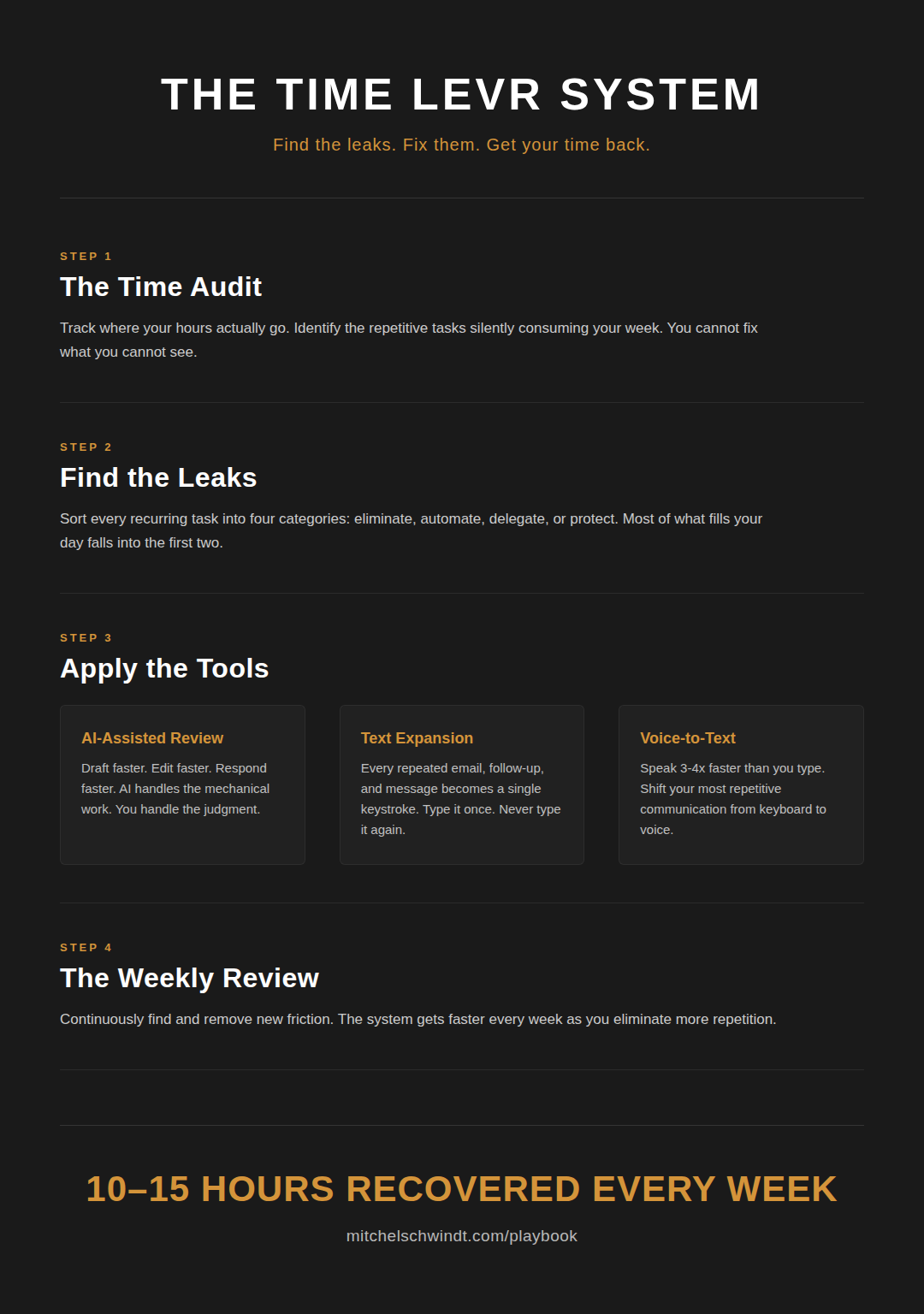
This is why the Time Levr System starts with a time audit.
Not a productivity hack. Not a new app. Not another thing to add to your stack. An audit. A structured, honest examination of where your hours are actually going.
The purpose of the audit is not to find what you're doing. You already know what you're doing. The purpose is to find what shouldn't be there.
Think of it the way Holmes would. You're not looking for clues. You're looking for the dog that isn't barking. You're looking for the silent leaks. The repeated tasks. The manual work that could be a template. The typed communication that could be dictated. The multi-step process that could be a single keystroke.
When you find them, you don't optimize them. You don't make them faster. You remove them.
That's the distinction that changes everything. Optimization is addition dressed up in efficiency clothing. You're still doing the work. You're just doing it slightly quicker. Removal is fundamentally different. The work no longer exists. The time it consumed is returned to you completely.
The Three Tools of Removal
Once the time audit reveals where the silent leaks are, the Time Levr System uses three specific tools to eliminate them.
AI-assisted review and revision. Not as a replacement for your thinking, but as an accelerator. The draft you would spend thirty minutes writing can be reviewed, restructured, and refined in a fraction of the time when AI handles the mechanical work and you handle the judgment. The key word is "assisted." You remain in control. The repetitive labor of drafting and editing is what gets removed.
Voice-to-text workflows. Most professionals dramatically underestimate how much time they lose to manual typing. You can speak roughly three to four times faster than you can type. When you shift your most repetitive communication from typed to spoken, you don't just save time. You remove an entire layer of friction between your thinking and your output. The bottleneck of your fingers on a keyboard disappears.
Text expansion systems. This is the simplest and highest-ROI tool in the entire framework. If you type the same phrases, the same sentences, the same paragraphs, the same email responses more than once, you are doing work that a machine should handle with a single trigger. A text expansion system turns those repeated outputs into shortcuts. Three keystrokes instead of three paragraphs. The repetition doesn't get faster. It gets eliminated.
None of these tools are autopilot. None of them run in the background while you do nothing. They require your input, your voice, your judgment. What they remove is the manual, repetitive labor that surrounds your actual thinking. They take the mechanical cost of your work and reduce it to nearly zero.
What Holmes Would See in Your Workday
If Sherlock Holmes sat behind you for a single workday and watched how you operate, he would not be impressed by how busy you are. He would not admire your discipline or your stamina or your ability to grind through an inbox.
He would notice the silence.
He would notice the deep work that never happens because the shallow work never stops. He would notice the creative thinking that has no room to exist. He would notice the strategic planning that gets pushed to "later" every single day. He would notice the career growth that stalled not because you stopped being talented but because you ran out of hours to invest in the things that compound.
And he would ask the question nobody else is asking.
Why isn't the dog barking?
Why aren't you doing the work that actually matters? Not because you don't want to. But because something silent is consuming the space where that work should live.
The answer, almost always, is repetition. Tasks you've done so many times they've become invisible. Work that feels necessary because it's always been there. Processes that nobody ever questioned because they never caused a crisis.
They didn't cause a crisis. They just quietly consumed your week, your month, your year, and eventually your career trajectory. All without making a sound.
Removal Is the Strategy
The lesson from Silver Blaze is not about dogs or crime scenes or Victorian detective work.
It's about the discipline of paying attention to what is absent.
In your work, what's absent is the time you should have. The focus you used to feel. The space for the work that creates real momentum in your career and your life.
That space was taken by repetition. And repetition is silent.
The fastest path to getting it back is not addition. It's not optimization. It's not working harder or waking up earlier or downloading another app.
It's removal.
Find the silent leaks. Eliminate them. And watch what fills the space they leave behind.
That's what the Time Levr Playbook is built to do. It starts with the audit. It ends with the removal. And the hours you recover are yours to use on the work that actually matters.
Start by listening for the dog that isn't barking.
Written by Dr. Mitchel Schwindt • Physician, Author, Entrepreneur, and Creator focused on mindset, resilience, productivity, AI leverage, and personal reinvention.